Curious about the Red Sea but nervous about breathing underwater? A Hurghada diving course for nervous person can begin with a small, informed step, not an immediate commitment to certification. It’s reasonable to want clear instructions and time to ask questions.
Discovery Diving (DSD) is an introductory experience, while certification training follows a structured learning path. Knowing the difference can help you choose a first step that matches what you want from diving.
Diving Around Hurghada Center offers introductory diving and recreational training in Hurghada. This guide explains the options and practical ways to discuss your concerns before you start.
Key Takeaways
- Nervousness alone doesn’t decide whether scuba is right for you. Comfort, honest communication, and an informed choice matter.
- Beginner training generally builds from knowledge to skill practice and supervised open-water training, with details shaped by the chosen agency program.
- Compare DSD with certification training to choose between trying scuba and working toward a recognized qualification.
- Prepare questions about your concerns, experience, and comfort level so you can discuss them with your instructor.
- A Hurghada diving course for nervous person can start with DSD or agency-specific certification training at Diving Around Hurghada Center.
A Hurghada diving course for a nervous person: begin with the right question
Curiosity and apprehension can sit side by side. You may want to see the Red Sea underwater while wondering what it feels like to breathe through scuba equipment, or whether you’ll be expected to move faster than you’re ready for. Nervousness alone doesn’t determine whether you’re ready to dive. Clear information, communication, and your own choice matter too.
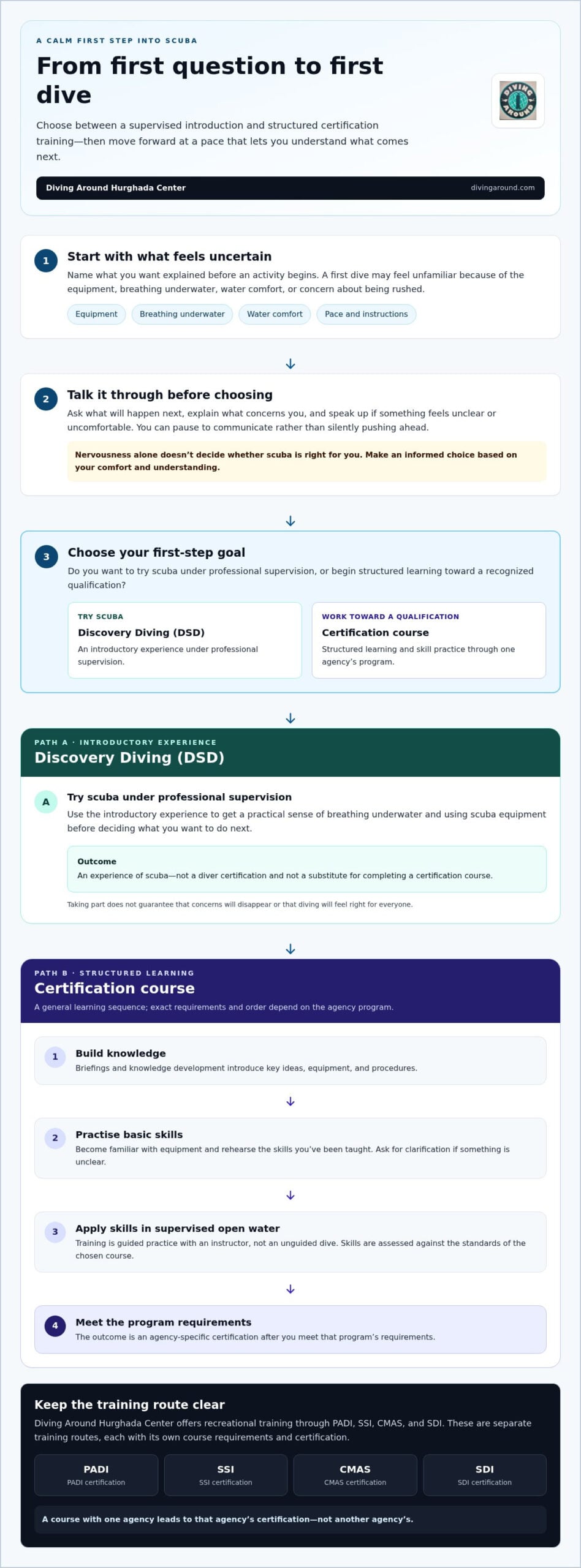
A beginner certification course is structured learning, not just a single underwater experience. It generally develops knowledge and practical skills before supervised open-water training. The exact structure depends on the agency and program. Discovery Diving (DSD), by contrast, is an introductory scuba experience under professional supervision, not a certification. That distinction can help you decide whether you want to try scuba first or begin training toward a qualification.
What might make a first course feel intimidating?
For one learner, it may be unfamiliar equipment. For another, it could be breathing underwater, feeling comfortable in the water, or worrying about being rushed. There’s no single beginner experience, and you don’t need to describe your feelings in a particular way. Before an activity begins, tell your instructor what concerns you and what you’d like explained. Specific questions make it easier to understand what will happen next.
If you want a general overview of scuba diving and its equipment, Scuba diving offers useful background. Bring any questions that remain to your training conversation.
Does feeling nervous mean scuba is not for you?
Not necessarily. Uncertainty about new equipment or an unfamiliar setting isn’t the same as deciding you don’t want to continue. Give yourself room to ask questions, understand what will happen, and speak up if something feels uncomfortable. You can pause to communicate rather than silently pushing ahead. No one can promise that fear will disappear or that diving suits everyone. The useful question is whether you feel informed and comfortable enough to choose the next step.
If you’re considering a Hurghada diving course for nervous person, first decide what you want from the experience: a supervised introduction or a structured path toward certification. Diving Around Hurghada Center offers DSD alongside recreational training through PADI, SSI, CMAS, and SDI. Each agency has its own program and certification, so understanding the options is a practical place to start.
How beginner scuba training builds skills one step at a time
A certification course builds skills in stages rather than asking a beginner to manage everything underwater at once. The general sequence includes learning essential knowledge, practising basic skills, and then applying them during supervised open-water training. The exact requirements and order depend on the agency program you choose.
What happens before a learner enters open water?
Course briefings and knowledge development introduce key ideas, equipment, and procedures before practical activities. Skill practice gives learners a chance to become familiar with the equipment and rehearse what they’ve been taught. It’s also an opportunity to ask for an explanation or raise a concern. Courses don’t all follow the same pace. Progress depends on the program and meeting its requirements.
Supervised training is guided practice with an instructor, not an unguided dive. Instructors assess skills against the standards of the chosen course. For a nervous learner, this means the focus is on demonstrating the required skills, not rushing through them. If something feels unclear, say so before moving on.
How do PADI, SSI, CMAS, and SDI fit into the choice?
Diving Around Hurghada Center offers recreational training through PADI, SSI, CMAS, and SDI. These are separate training routes, each with its own course requirements and certification. A PADI course leads to a PADI certification, for example, not an SSI, CMAS, or SDI certification. You can read about PADI’s approach through PADI Scuba Diving Courses and Certification.
When considering a Hurghada diving course for nervous person, focus on how the chosen program progresses and which skills you’ll need to demonstrate. The agency matters, but so does understanding what comes next in your training. If you’re considering certification, explore beginner scuba training in Hurghada and note down questions to discuss before starting.
DSD or certification course: which first step suits a hesitant beginner?
Choose according to what you want from your first step. Discovery Diving (DSD) introduces scuba under professional supervision. A certification course is a structured learning route for people ready to develop and demonstrate skills. Neither option guarantees that diving will feel right for everyone. Use the difference to make an informed choice.
| Option | Purpose | Learning commitment | Outcome |
|---|---|---|---|
| DSD | Try scuba under professional supervision | An introductory experience, not a full certification course | Experience scuba; no diver certification |
| Certification course | Learn and demonstrate scuba skills | Structured training following one agency’s program | Agency-specific certification after meeting its requirements |
When might Discovery Diving be a useful first experience?
DSD may suit someone who wants to find out what breathing underwater and using scuba equipment feel like before choosing a training pathway. The experience can give you a practical reference point for deciding what you want to do next. It doesn’t guarantee that your concerns will disappear, and it isn’t a substitute for completing a certification course. Taking part in DSD doesn’t make you a certified diver.
When might a beginner choose a certification course?
If you’re ready to work through structured learning and practise skills, a beginner certification course may be the more direct route. Certification follows completion of the relevant agency’s requirements, not simply participation in an introductory dive. The program and qualification belong to the agency you choose.
For a Hurghada diving course for nervous person, the choice can be straightforward: choose DSD if you want an introduction first, or consider certification training if you’re ready to pursue a qualification. Diving Around Hurghada Center offers DSD and recreational training through PADI, SSI, CMAS, and SDI. Take time to understand the pathway and raise concerns before you begin.
Prepare for a scuba course in Hurghada without adding pressure
A little preparation can make your first training conversation clearer. Before you arrive in Hurghada, write down what you’re unsure about. You might want to understand how equipment is introduced, what an open-water session involves, or what happens if a skill needs more practice. You don’t need to have every concern neatly explained before you begin.
What should you tell your instructor?
Be specific about what’s on your mind. For example, tell your instructor if unfamiliar equipment, breathing underwater, water comfort, or the learning pace is worrying you. Mention any previous experience, even if it was limited. If an instruction or skill isn’t clear, ask for another explanation before attempting it. Communicate discomfort rather than concealing it. You shouldn’t feel that you have to push through discomfort just to complete a dive.
What can you control as a beginner?
You can listen carefully, ask questions, and follow the instructor’s briefing and the requirements of your chosen agency course. You can also be honest about what you understand and where you need clarification. These steps can’t determine exactly how you’ll feel underwater, but they help you make decisions with better information.
If you’re considering a Hurghada diving course for nervous person, remember that taking part is a choice, not an obligation. If you decide you don’t want to continue, say so. Your instructor needs to know how you’re feeling to guide the training responsibly. Staying silent can make it harder to respond to your concerns.
Keep your notes simple. A short list is enough to start a clear conversation. You might ask, “What should I expect next?” or “Could you explain that instruction again?” You don’t need to prove anything or match another learner’s pace. Follow the briefing, raise concerns as they come up, and make your decision one step at a time.
Ready to consider an introductory experience or structured training? Explore beginner diving options with Diving Around Hurghada Center.
Choose your next step with Diving Around Hurghada Center
Your first choice doesn’t have to settle your whole future in scuba. Start with what you want from this experience: an introduction to diving, or structured training toward a certification. Both are valid choices, not tests of courage. If you’re weighing a Hurghada diving course for nervous person, focus on which option feels like a clear, informed next step.
A simple decision framework for nervous beginners
- Choose Discovery Diving (DSD) if your immediate goal is to try scuba under professional supervision before deciding whether to pursue training. It’s an introductory experience, not a certification.
- Consider certification training if you’re ready to follow a structured learning pathway and work toward a qualification. The course and resulting certification belong to the agency you choose, such as PADI, SSI, CMAS, or SDI.
Diving Around Hurghada offers DSD and recreational training through these agencies. Professional instruction and attention to safety are central to learning, but no instructor can promise how you’ll feel or make the decision for you. Your questions and comfort are part of the conversation.
Keep the first decision small and informed
Before choosing, name what you want from your first experience. Is your goal to find out how scuba feels, or to begin learning skills for certification? Then discuss any concerns with your instructor before activities start. Ask what the next step involves, share what makes you unsure, and take time to understand the option you’re considering. You don’t need to commit to more than the choice in front of you.
A calm start is a clear one: understand the difference between an introduction and a course, ask questions, and decide whether you feel ready to proceed. Diving Around Hurghada welcomes beginners exploring either path, with training delivered through the selected agency’s program.
Explore diving options with Diving Around Hurghada
Take your first step at a pace that feels right
Nervousness doesn’t have to decide your next move. The key is understanding the difference between an introductory Discovery Diving experience and a certification course: one lets you try scuba under professional supervision, while the other builds skills toward an agency-specific qualification.
Before choosing, consider what you want from your first experience and share your questions or concerns with your instructor. You can explore scuba without committing to certification, or begin structured training when that feels like the right fit.
Diving Around Hurghada Center offers Discovery Diving and recreational courses through PADI, SSI, CMAS, and SDI. If you’re considering a Hurghada diving course for nervous person, take time to understand your options and choose the next step that suits you.
Explore diving options with Diving Around Hurghada Center. Your first step can be thoughtful, and it’s yours to choose.
Frequently Asked Questions
Is Hurghada suitable for a nervous beginner diver?
Hurghada offers beginner scuba options, but whether diving suits you depends on your comfort, the conditions, and the activity you choose. Diving Around Hurghada Center offers Discovery Diving (DSD) and beginner training, giving you different ways to approach scuba. Explain your concerns to the instructor before starting and follow their guidance. No course can promise you’ll feel comfortable underwater, and choosing not to continue is a valid decision.
Can I try scuba diving in Hurghada before taking a certification course?
Yes. Diving Around Hurghada Center offers Discovery Diving (DSD), an introductory experience for people who want to try scuba under professional supervision. DSD is not a certification and doesn’t qualify you as a certified diver. If you decide to continue with training, choose a specific agency’s course and complete its requirements. This lets you explore scuba first without confusing an introductory dive with certification.
Do I need to be confident before starting a scuba course?
No. You don’t need to pretend you feel confident or hide what worries you. Tell your instructor what feels uncertain, and ask for clarification if an instruction isn’t clear. Confidence differs from person to person, and a course can’t guarantee a particular emotional response. Make your decision based on your comfort, the information you receive, and your instructor’s guidance, not pressure to prove yourself or keep up with anyone else.
What happens if I feel nervous during a beginner dive course?
Tell your instructor as soon as you feel uncomfortable or uncertain. Follow the briefing and the instructor’s directions, and don’t conceal your concerns to keep the activity moving. The appropriate response depends on the situation and course procedures. You can decide not to continue. Completing a dive isn’t more important than making a safe, informed choice, so speak up rather than pushing through discomfort without guidance.
Is DSD the same as an Open Water certification course?
No. Discovery Diving (DSD) is an introductory scuba experience, while an Open Water course is structured training toward certification after you meet the chosen agency’s requirements. Diving Around Hurghada Center offers recreational training through PADI, SSI, CMAS, and SDI. These are distinct programs, and each agency’s course leads to its own certification. Taking part in DSD alone doesn’t make you a certified diver.
Should a nervous beginner choose DSD or a full certification course?
Choose according to your goal and readiness for structured training. DSD may suit you if you want to try scuba before deciding whether to pursue a course. Certification training is for learners who want to develop required skills and work toward an agency-specific qualification. If you’re considering a Hurghada diving course for nervous person, think about what you want from the experience and share your concerns with the instructor before choosing.