Imagine descending through the crystal-clear waters of the Red Sea, where history rests silently on the ocean floor. For wreck diving enthusiasts, there is one legendary destination that sits at the top of every bucket list: Shaab Abu Nuhas. Known famously as the “Ships’ Graveyard,” this treacherous reef has claimed more vessels than any other in the region, creating an unparalleled underwater museum.
Whether you are looking to book your next hurghada diving course, checking out hurghada diving prices for an unforgettable day trip, or seeking the ultimate red sea diving adventure, our premier diving center hurghada is ready to take you there. At ´Diving Around´ Hurghada, we offer world-class padi diving, ssi diving, and sdi diving experiences tailored to every level.
Ready to explore the deep? Let’s dive into the hauntingly beautiful stories behind the four most famous shipwrecks of Abu Nuhas.
Since the opening of the Suez Canal in 1869, vast numbers of ships have used this passage as the main route from Europe to Asia. The proximity of Shaab Abu Nuhas to the shipping lanes, combined with its exposed northerly aspect, has meant that this reef has claimed more ships than any other in the Red Sea.
This wreck graveyard is situated roughly three hours north of Hurghada. At least four complete wrecks lie at Shaab Abu Nuhas: the Giannis D, the Carnatic, the Chrisoula K, and the Kimon M. Each of these main wrecks, along with other debris scattered nearby, has a unique story to tell about its sinking—some far more dramatic than others. While each wreck possesses its own distinct personality, they all share a stunning underwater beauty that should not be missed by any diver bound for the Red Sea. We are proud to offer this spectacular scuba diving Hurghada excursion to our guests upon request.
To summarize, the Abu Nuhas wrecks are ironic in a way; though completely unrelated to one another, they all sank within a few hundred meters of each other. If you are a wreck lover, you should definitely check out this dive site.
At the front of the wrecks, the seabed at the base of the reef sits between 25–27 meters. For example, the hole in the port side of one of these giants rests at 17 meters, from where everything gets gradually deeper until you reach the stern, where the seabed drops to 32 meters.
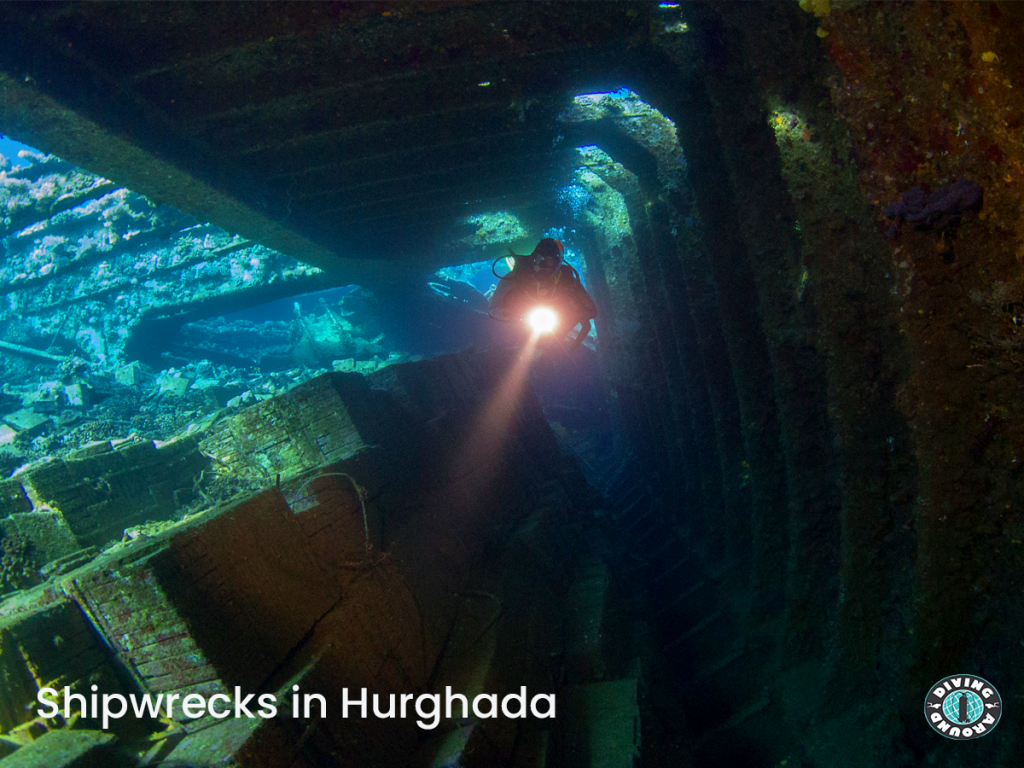
She met her fate when she hit the reefs of Abu Nuhas on 31 August 1981 while in rout to Jadda, Saudi Arabia carrying cargo of tiles. This wreck has cracks and holes everywhere that allows you to see the light rays passing through making it beautiful for filming. You may also enter from any direction as it has big opening through the rear as well as the bow which positioned only five meters under water. The tiles that was caried remain intact which gives a realistic flavor to a life ship.
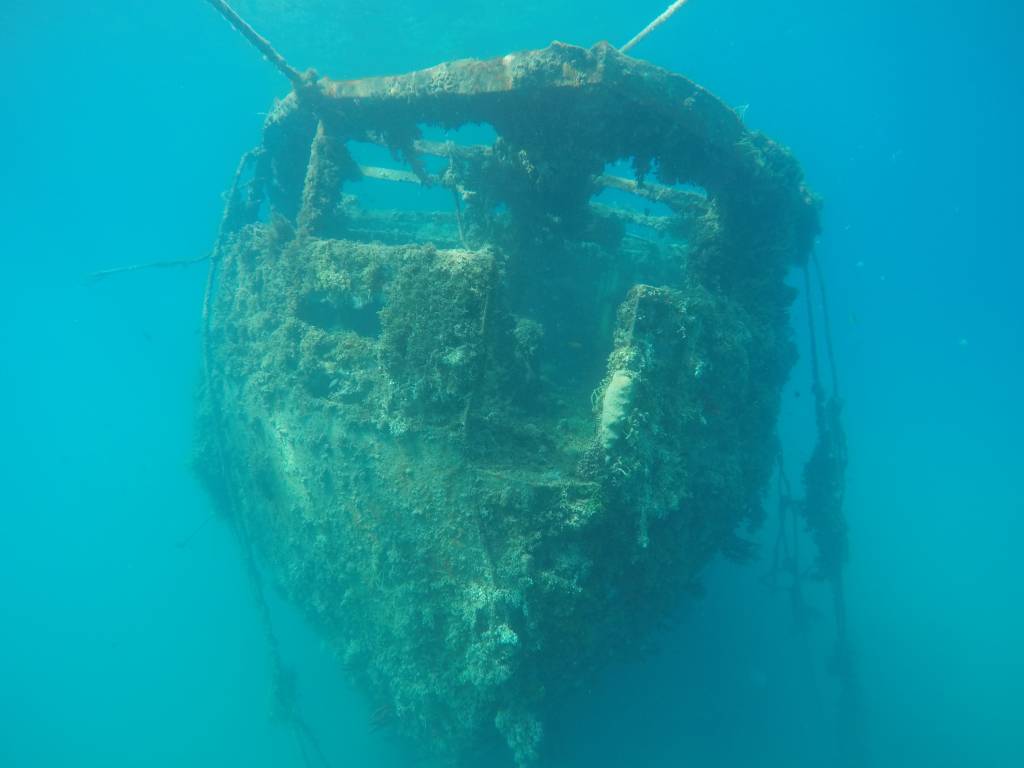
This ship angled in the water in a way that ranges between 4 meters and 24 meters from beginning to end. It was sunk in April 1983 with another cargo of Timber. The middle of the ship is all broken up but the stern of the ship still intact. The front portion grown with life corals and became the home to many creature. The engine room is quite spacious and you can maneuvor inside easily.
This is a beautiful ship and the oldest among the rest of its sunken peers. It is absolutely magnificent to look at. It was built in 1862 as a steam ship and operated as cargo and passengers’ vessel for few years before meeting its fate on September 1869 due to a strong current that throw her over the reefs of Abu Nuhas. Among the cargo were cotton, wine, and 40 thousand pounds of gold yet to be fully recovered. This wreck is also the deepest as it lays between 16 and 27 meters of depth. So, Advanced divers may find this very appealing to explore.
In December 1978, the Kimon M loaded 4,500 tons of bagged Lentils in the Turkish port of Iskenderun. On completion, the hatches were battened down and the ship prepared for the long journey to Bombay. It took just over two days for the Kimon M to reach Port Said and about the same time again to reach Suez. From here, the Captain had to navigate the narrow confines of the more hazardous upper reaches of the Straits of Suez and for two days he spent most of his time on the bridge – giving his personal attention to every detail of bringing his vessel safely into the Red Sea.
It is not known which wreck the Kimon M claims to have hit prior to grounding. This was almost 3 years before the Chrisoula K would go aground, but other ships are known to have grounded here and then been successfully refloated. Perhaps, one such grounded vessel gave the impression of being in deep water and the Kimon M simply meant to go around her? More importantly, of course, the position given by Lloyds puts the Kimon M right where she is still found to this day.