
The logo on your certification card may matter less than the instructor guiding your first breaths underwater. If you’re weighing a padi vs ssi certification, it’s understandable to wonder whether one will travel better or suit you more. Both agencies offer globally recognized recreational training, and their entry-level courses cover the core skills you need to begin diving.
The practical differences are more about how training is delivered. PADI follows a structured course sequence, while SSI gives instructors flexibility to adapt the learning process to a student’s pace. Neither approach is automatically right for everyone. Your comfort, learning preferences, and the instructor’s guidance all matter.
This comparison explains what PADI and SSI share, where their training systems differ, and what certification portability means when you travel or continue your education. You’ll also see how to think about your next course after Open Water. In Hurghada, Diving Around Hurghada Center offers both PADI and SSI training, so you can choose the pathway that feels right for your first steps in the Red Sea.
Key Takeaways
- Both PADI and SSI provide structured recreational training, but their teaching approaches can differ.
- Compare the padi vs ssi certification options by considering how you prefer to learn, not just the agency name.
- Understand the difference between certification recognition and a dive operator’s requirements for a particular trip or site.
- Look beyond the course card: clear instruction, guided practice, and personal comfort matter throughout training.
- Diving Around Hurghada Center offers separate PADI Open Water and SSI Open Water courses for divers starting in Hurghada.
PADI vs SSI Certification: Similarities and Differences
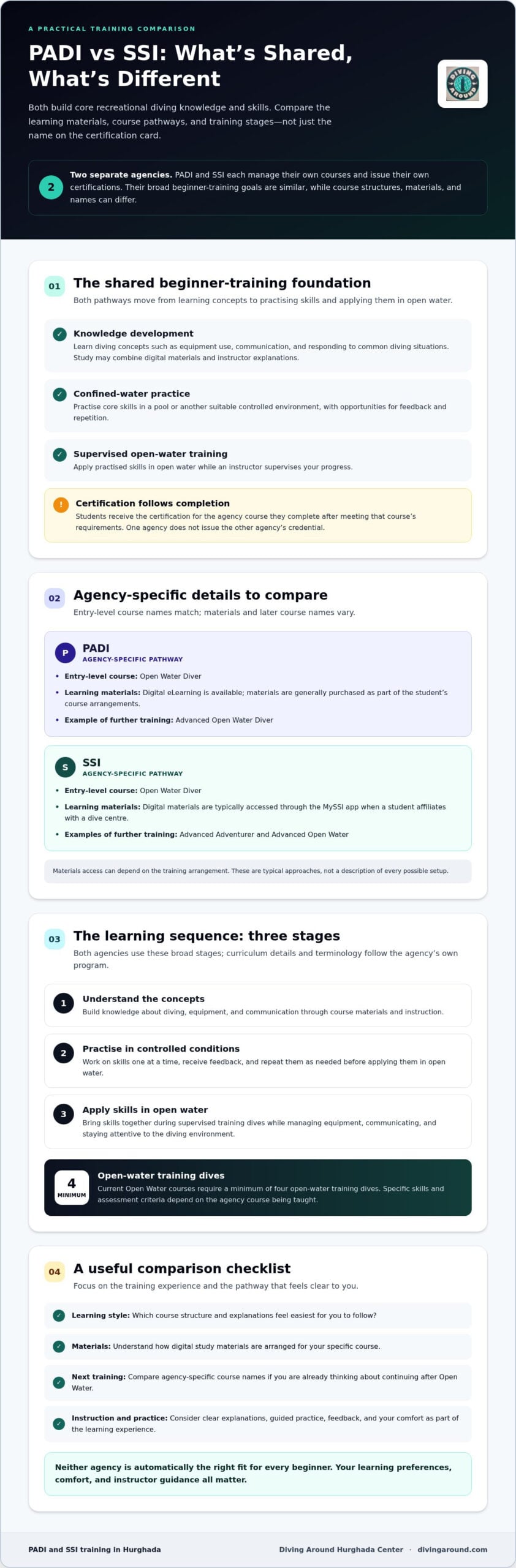
Both PADI and SSI provide structured recreational scuba training, but course details and learning materials can vary. A certification agency sets its training program and issues credentials when a student meets its requirements. PADI and SSI are separate agencies, and each awards its own certification.
The choice is not between scuba training and no training. Both pathways build knowledge, develop in-water skills, and apply those skills during supervised open-water training. Their broad goals are similar, but course structures, materials, and names used for later training may differ.
What PADI and SSI Open Water courses have in common
Each agency offers an entry-level recreational course for people learning to dive. Students study diving concepts, practise essential skills in a controlled setting, then apply their learning in open water under instructor supervision. Certification follows only after the student completes the requirements of that agency’s course.
This shared learning journey gives beginners a clear foundation. The instructor’s explanations, feedback, and supervision matter alongside the curriculum, as does the time each student spends practising. A course card identifies the agency program completed; it does not mean both agencies issued the same credential.
Where the agency systems may differ
Course names and study-material arrangements are two visible distinctions. Digital options are available through both agencies, though the usual access model differs. PADI eLearning materials are generally purchased as part of the student’s course arrangements. SSI digital materials are typically accessed through the MySSI app when a student affiliates with a dive centre.
| Comparison point | PADI | SSI |
|---|---|---|
| Entry-level course | Open Water Diver | Open Water Diver |
| Learning materials | Digital eLearning is available; materials are generally purchased. | Digital materials are typically provided through MySSI when affiliated with a dive centre. |
| Further training | Includes courses such as Advanced Open Water Diver. | Includes courses such as Advanced Adventurer and Advanced Open Water. |
Material access can depend on the training arrangement, so the table describes typical approaches rather than every possible setup. Each agency manages its own course system and credentials. A PADI course remains a PADI course, and an SSI course remains an SSI course.
Both agencies aim to prepare divers with core recreational knowledge and skills, while their course names, learning materials, and training pathways remain agency-specific.
When comparing PADI vs SSI certification, avoid assuming one system is automatically easier, safer, or better for every beginner. Agency curricula set the framework, while instructors guide how students learn and practise within it. Consider which course pathway feels clear and comfortable, and include the instructor’s guidance in your decision.
How PADI and SSI Structure Beginner Scuba Training
Beginner training moves from understanding scuba concepts to practising skills and then applying them in open water. This sequence gives students time to build familiarity before bringing several new tasks together underwater. PADI and SSI both use knowledge development, confined-water training, and supervised open-water dives, though the details and terminology follow each agency’s curriculum.
Learning theory and practising core skills
Knowledge development helps students understand what they’re doing and why. Topics include equipment use, communication, and responding to common diving situations. Learning may use digital materials, instructor explanations, or a combination of formats. SSI’s official overview offers background on the organization and its approach to diver education.
Next, students practise core skills in confined water, such as a pool or another suitable controlled environment. This setting lets a learner focus on one task at a time, receive feedback, and repeat a skill as needed. For example, becoming more comfortable clearing a mask can make it easier to focus on your surroundings during an open-water dive.
The curriculum sets learning objectives, but instructors may explain and demonstrate skills in different ways. If you need another demonstration or more practice, speak up. Clear explanations and calm feedback can help make new skills easier to understand.
From training dives to an entry-level certification
Open-water training is where students apply skills they have already practised, while an instructor supervises their progress. The focus is not simply on completing a sequence. Students also learn to manage equipment, communicate, and stay attentive in a real diving environment. In Hurghada, this transition takes place in the Red Sea, so comfort in the water and steady preparation are important parts of the learning experience.
Both agencies require students to complete knowledge development, confined-water training, and open-water training. Current Open Water courses require a minimum of four open-water training dives. Specific skills and assessment criteria belong to the agency course being taught, so use that course’s materials and instructor guidance as your reference.
Before each session, review the relevant learning material, listen carefully to the briefing, and tell your instructor if you feel uncertain about a skill. Asking a question is a useful part of learning, not a setback. Feedback helps you understand what to adjust before moving on.
A certification records that you completed the required training; it isn’t a permanent guarantee that your skills stay current without practice. After time away from diving, a refresher can help you regain comfort and review essential skills before returning to the water.
The padi vs ssi certification choice matters less than progressing at a pace that supports understanding and confidence. Diving Around Hurghada Center offers separate PADI Open Water and SSI Open Water training pathways in Hurghada. Explore the Open Water course options to compare the two agency pathways.
Will a PADI or SSI Certification Be Recognized When You Travel?
In general, yes. PADI and SSI recreational certifications are globally recognized and align with international standards for recreational diver training. A PADI Open Water Diver or SSI Open Water Diver certification can typically be presented when arranging recreational dives with an operator that accepts that certification level. Recognition is broad, but it does not mean every operator, dive, or training course has identical requirements.
Your certification shows the training level you completed. An operator may also consider your recent diving experience, comfort in the water, and the demands of a particular site or activity. If you haven’t been underwater for a long time, you may be advised to refresh your skills before joining a dive, even if your certification remains valid.
Using your certification at dive destinations
When arranging diving in Hurghada or elsewhere, be ready to show proof of certification. Keep your agency card accessible, whether it’s a physical card or a digital credential. Have your logbook or another record of recent dives available if you use one. These details help the team understand both your certification level and recent experience.
Before a dive, an operator may have participation requirements based on the site, conditions, or planned activity. A certification card alone does not establish that every dive is suitable for every diver. Share relevant information about your experience and recent time underwater so the team can guide you toward an appropriate plan.
When travelling to the Red Sea, keep your certification details easy to retrieve rather than relying on memory or a photo that may be difficult to read. If you’ve been away from diving, mention that too. A refresher or check dive may be recommended based on your circumstances and the operator’s assessment.
Continuing training across agencies
Recreational divers can often continue training with an agency different from the one that issued their entry-level certification. For example, an SSI-certified diver may be able to pursue a PADI course, or a PADI-certified diver may be able to continue with SSI. The original credential does not change: the next course and certification belong to the agency delivering that training.
Progression is not automatic. Each next course has its own prerequisites, and an instructor or training agency may need to assess whether your existing certification meets them. Review the current requirements for the specific course with the relevant agency before planning a cross-agency step. Course titles can sound similar while covering different training pathways.
In short, PADI and SSI certifications can both support recreational diving and further training, but each agency’s credentials and course requirements remain distinct. For diving in Hurghada, bring proof of certification and be ready to discuss your recent experience and the kind of dive you plan to do.

How to Choose Between PADI and SSI for a Hurghada Dive Course
Choose by looking at your learning preferences, the course pathway, and what you hope to do after your first certification. The PADI vs SSI decision isn’t a choice between a “right” and “wrong” agency. Focus on clear instruction, time to practise, and feeling comfortable asking questions.
Match the course to how you prefer to learn
Start with study format. Do you prefer working through digital lessons, reading printed material, or learning through discussion with an instructor? PADI and SSI both offer digital learning, but their material-access arrangements can differ. Think about what helps you understand and retain information rather than assuming one format suits every student.
Then consider how you want to communicate during training. Clear explanations, helpful demonstrations, and constructive feedback can make unfamiliar skills feel more manageable. Ask yourself whether the course plan is easy to follow and whether you feel at ease raising concerns. A brand name alone can’t tell you how well a particular teaching approach will fit.
For a Hurghada visit, include the setting in your decision without letting the destination rush you. Learning in the Red Sea can be part of a wider travel experience, but your comfort and preparation should guide your pace. Give yourself room to focus on learning, not simply on finishing a course during a holiday.
Think beyond the first certification
Consider where you might dive next and whether you expect to continue training. If you’re interested in further courses, compare the progression available through each agency. PADI and SSI use distinct course names and credentials. For example, PADI offers Advanced Open Water, while SSI offers Advanced Adventurer and Advanced Open Water. Similar-sounding titles do not automatically mean identical course structures or requirements.
Cross-agency progression may be possible, but the next course’s prerequisites still apply. If you already have a likely next step in mind, review the relevant agency’s current requirements and consider how that course fits your plans. You don’t need to map out an entire diving career before starting. A simple goal, such as building experience before choosing a specialty, can help you select a practical first pathway.
Once certified, you can keep developing confidence through regular recreational dives. Certified divers visiting Hurghada can explore daily diving trips in Hurghada as part of their continuing experience.
Diving Around Hurghada Center offers separate PADI Open Water and SSI Open Water courses. Compare the course information and choose the path that fits your learning preferences and plans. Explore PADI and SSI Open Water training as you plan your first steps in the Red Sea.
Learn with PADI or SSI at Diving Around Hurghada Center
Still weighing the padi vs ssi certification options? At Diving Around Hurghada Center, you can choose between two distinct recreational training pathways: PADI Open Water and SSI Open Water. Each course follows its own agency’s curriculum and leads to a certification issued by that agency. Choose based on how you prefer to learn and where you hope diving will take you.
A choice of two distinct training systems
Both courses introduce the knowledge and practical skills needed to begin recreational scuba diving. The credentials aren’t interchangeable labels for one combined course. PADI Open Water is a PADI certification, and SSI Open Water is an SSI certification. Keeping that distinction clear helps you understand which course you’re enrolling in and how to describe your training when you dive or study later.
Before deciding, think about the learning format that feels comfortable, the way you like to receive explanations and feedback, and whether you have a preferred agency pathway for future training. You don’t need to choose based on assumptions that one brand is easier or better. Clear communication and feeling ready to practise are more useful guides.
Take the next step with confidence
Use this checklist to focus your decision:
- Learning preferences: Consider how you like to study and what helps you understand new information.
- Course pathway: Compare the PADI or SSI course structure and the agency’s names for later training.
- Personal comfort: Choose an environment where you feel able to ask questions, practise, and take feedback on board.
- Future plans: If you already have a next course in mind, review its agency-specific prerequisites before choosing your starting point.
For a visitor to Hurghada, learning in the Red Sea can be a meaningful part of a trip. Give yourself space to focus on training, not just the certificate. Your first course is a foundation, and confidence grows through practice and continued diving.
The right choice is the course structure that fits your goals, learning preferences, and comfort with the instruction. Diving Around Hurghada Center offers both PADI Open Water and SSI Open Water as separate courses, so you can explore either pathway while keeping the agencies and their credentials distinct.
Explore PADI and SSI training with Diving Around Hurghada Center and take your next step toward diving in Hurghada.
Take Your First Step Toward Red Sea Diving
Choosing a padi vs ssi certification path is one part of beginning your diving journey. Think about how you want to feel underwater: prepared, curious, and comfortable enough to keep learning. Let that goal guide your choice, and give yourself permission to ask questions and build confidence one skill at a time.
Diving Around Hurghada Center has been established in Hurghada since 2002 and offers separate PADI and SSI recreational training pathways. Your course can be the start of discovering the Red Sea and developing skills to build on as you gain experience.
You don’t need to settle every future diving plan before you begin. Choose a starting point that feels clear and supportive, then let each new experience shape what comes next. Explore PADI and SSI training with Diving Around Hurghada Center and take your first step toward diving with confidence.
Frequently Asked Questions
Are PADI and SSI certifications recognized internationally?
Yes, PADI and SSI recreational certifications are internationally recognized and align with standards for recreational diver training set by the WRSTC and ISO. For a Hurghada dive, present your certification so the operator can review your qualification level. Recognition doesn’t mean every operator has identical participation requirements, so your experience, recent diving, and the planned activity may also matter.
Can I continue my scuba training with SSI after earning a PADI certification?
Yes, you may be able to take an SSI course after earning a PADI certification. Your PADI credential remains a PADI certification, while any new course you complete through SSI leads to an SSI credential. Before enrolling, review the SSI prerequisites for that specific course and have your existing certification details ready.
Can I continue with PADI after earning an SSI certification?
Yes, an SSI-certified diver may be able to progress through a PADI course. The SSI card doesn’t become a PADI credential; it serves as evidence of your previous training. If you’re considering a PADI course after an SSI entry-level course, review the current PADI prerequisites for that next step before making plans.
Does a PADI or SSI scuba certification expire?
No, recreational certifications such as Open Water Diver are valid for life and don’t expire. However, a certification card doesn’t confirm how recently you’ve dived or how comfortable you feel now. If you’ve had a long break, an operator may recommend a refresher before a dive. Keep your certification information accessible when arranging diving in Hurghada.
Do I need to carry a physical certification card when diving in Hurghada?
Not necessarily. If your agency provides a digital certification card, keep it accessible on your device, and consider carrying a physical card as a backup when practical. The key is being able to show clear proof of your certification. Keep your logbook or recent dive records available too, if you use them, as they can help explain your experience.
Can I start a PADI or SSI course before travelling to Egypt?
Often, you can begin the knowledge-development portion online before travelling, depending on the course and your enrolment arrangements. The in-water training still needs to be completed through the relevant agency’s program with an instructor. Keep your course and learning records accessible when you arrive in Hurghada, and know which agency’s course you started.
What should I do if I have a certification but have not dived recently?
Tell the dive operator how long it has been since your last dive and describe your recent experience honestly. A refresher can help you review equipment use and core skills before returning to open water. In Hurghada, the operator can consider your certification, activity, and comfort level when discussing an appropriate next step. Don’t feel pressured to join a dive before you’re ready.